
Rostropovich Plays It Wrong
On Arrogance, Authority, and Expertise

At seven o’clock one Saturday evening, with an hour to spare before I was due at another event, I looked at my watch and realized that a wedding ceremony was taking place half a block from my office.
The wedding was at the St. Regis Hotel, at Fifth Avenue and 55th Street. I had arranged the music several months earlier and had no reason to attend. The musicians had their instructions. The hotel had its schedule. I was expected somewhere else at eight.
Still, I left the office.
I walked briskly toward Fifth Avenue, entered the hotel lobby, and climbed the stairs to the second floor two at a time. Near the top, I encountered the banquet service manager, a long-time friend.
“Is the ceremony still going on?”
“Yes,” he said.
The wedding was being held in the Versailles Room. I entered the adjacent Library, closed the large double doors behind me and sat alone in one of the room’s upholstered chairs.
The Library was a small jewel of a room, intimate and quiet, its walls paneled in dark mahogany trimmed in 1904. On the other side of the doors, perhaps twenty feet away, the bride and groom were standing before their guests.
One long wall of the Versailles bordered Fifth Avenue. From the second floor, the city remained close enough to intrude. Outside, sirens could rise between the buildings. Taxi drivers were known to lean on their horns at the wrong moment. Reversing delivery trucks may beep out their own Morse code.
Inside, a guest might cough, rustle a program, or begin the slow, crackling work of unwrapping a lozenge.
During most of a wedding ceremony, someone is speaking. The officiant addresses the couple and vows are recited. A reading may be given.
But during a musical interlude, everyone stops.
If the city cooperates and the guests remain still, the space enters a suspension of time.
Then the cello sings.
When the first notes of Bach reached me through the mahogany doors, I turned my wrist toward the light and watched the second hand.
I was not merely listening to the music.
I was timing it.
Three weeks earlier, the couple had been sitting across from me in the conference room of my office.
The groom was about sixty-five, trim and well-preserved, with the composed bearing of a man accustomed to speaking from the head of a table. He mentioned early in the conversation that he served on the board of the Alvin Ailey Dance Company.
His fiancée sat quietly beside him. She was in her early thirties.
She was, as he put it, “a retired ballerina.”
He took pride in saying it often.
During the months we worked together, I heard the story a few more times. He was a retired CEO and she was a retired ballerina. They had no plans to have children. After the wedding, they intended to just travel.
When we met to finalize the music selections, the groom announced that their first dance would be “Two for the Road.”
He said the title in the manner of someone expecting to explain it.
“Do you know the song?” he asked.
“Yes.”
He looked at me more closely.
“You know ‘Two for the Road’?”
“I know it quite well.”
Years earlier, when I was in college, my trumpet teacher had played the song as a soloist. He performed it on flugelhorn rather than trumpet, giving Mancini’s melody a softer, warmer sound. During one lesson, he placed the sheet music on the stand and told me to learn it.
“It’s a beautiful song,” I told the groom.
He appeared pleased, but still slightly surprised that the thirty-year-old sitting across from him had recognized it.
“Most people don’t know it,” he said. He was probably right.
The choice suited them. Their marriage, as he described it, would not be organized around children, careers or Monday mornings. They were finished with those obligations, or at least he decided they were. Their plan was to leave one place for another, together.
Two for the road.
We discussed the reception music and then moved on to the ceremony.
The groom leaned forward and fixed me with the look of a chairman addressing someone at the far end of a boardroom table.
“First,” he said, “I want the telephone number of the cello player. I want to speak to him.”
“We don’t normally have clients speak directly with individual musicians.”
“I want to speak to him.”
“What would you like to tell him?”
There is an interlude during the ceremony, he explained, and he wanted the Prelude from Bach’s Cello Suite No. 1.
That presented no difficulty. Any professional cellist I would hire to perform at the St. Regis would know it.
“Some cellists play it much too fast,” he said.
Then he named Mstislav Rostropovich.
“Rostropovich plays it wrong.”
“Much too fast.”
His fiancée said nothing.
Rostropovich was not simply a competent musician whose interpretation had failed to please one listener. He was one of the most celebrated cellists of the twentieth century.
The groom did not say that he preferred another performance. He did not say that Rostropovich’s interpretation was too fast for the atmosphere he wanted during the ceremony.
He said it was wrong.
Keeping my expression blank, I asked, “What metronome marking do you prefer?”
The groom’s expression changed.
The retired ballerina lowered her head.
It was a small gesture, but one that suggested she might have witnessed this sequence before: the pronouncement, the challenge and the moment when certainty encountered a question it had not anticipated.
“I don’t know the metronome marking,” he said. “I just know it shouldn’t be played so fast.”
He thought for a moment.
“It should be about two minutes and twenty-three seconds. Maybe two minutes and twenty-four. That’s how long the Yo-Yo Ma recording is.” He had read the back of the CD cover.
“Then I’ll review that recording with the cellist and make sure the tempo is what you want.”
He looked at me as though I had resolved only part of the matter.
“I’d feel better if I could speak to him.”
“I’m sure you would feel better if you did,” I said. “But I’ll take it from here.”
Meanness and arrogance are not quite the same thing.
Meanness may be indiscriminate. Arrogance is more exact. It says: I understand this better than you do, I possess the standing to judge it, and I intend to make you feel the difference between us.
For arrogance to work, there must be some truth beneath it. Without truth, it is merely bluster. The groom had listened closely enough to distinguish among performances. He knew which one he preferred and had noted its running time.
His preference was legitimate.
But his certainty traveled farther than his knowledge.
A listener needs no musical training to know what moves him. He was entitled to prefer Yo-Yo Ma to Rostropovich, a slower interpretation to a faster one. But the word wrong claimed an authority that taste alone could not confer.
Bach left no metronome marking for the Prelude. The metronome would not be invented for several decades. Musicians have played it for generations at different tempos, with different phrasing and different ideas about historical practice.
The groom had settled the matter in a sentence.
I recognized the maneuver because I had used it myself. His arrogance seemed habitual; mine, I told myself, emerged only when the occasion demanded it.
I did not regard arrogance as a disposition so much as a tool, kept in reserve for someone who had wasted enough of my time, supplied enough false information, or spoken with great confidence about something I understood better.
Its force did not come from volume. When I used it, I relied on precision.
The danger was that the person carrying the weapon also decided when the occasion justified drawing it.
The groom had spoken down to me and attempted to bypass me. I answered with a question he could not answer.
I had the facts on my side.
I also enjoyed asking it.
He may have been performing for his fiancée. Decades of running a company may have taught him that certainty shortened discussions, a habit that followed him into smaller encounters with waiters, doormen, and talent agents.
Perhaps his fiancée admired it. Perhaps she had merely seen it many times before.
When she lowered her head, she offered no explanation.
Only recognition.
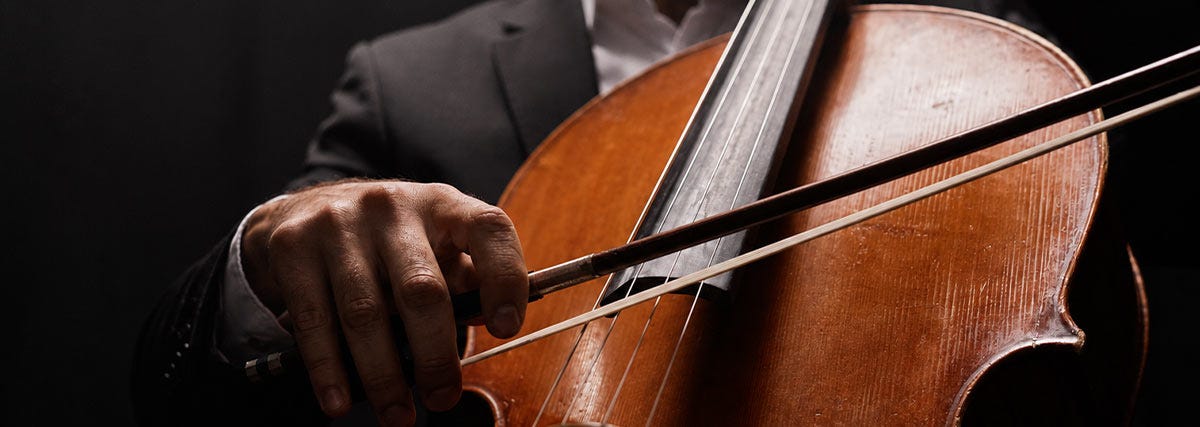
In the Library at the St. Regis, the Prelude began through the mahogany doors.
I could not see the musician. I could not see the couple, the officiant, or the guests. I heard only the cello while the ceremony proceeded in the Versailles.
For those few minutes, Fifth Avenue paused.
No siren rose from below. No guest unwrapped a honey-flavored Halls.
The cello sang.
The familiar arpeggiated chords moved upward and fell back again, each phrase entering the empty room where I sat.
I watched the second hand.
The final measures began.
The cellist slowed into the last phrase, allowed the closing notes their space and released the sound into the room.
Two minutes and twenty-three seconds.
I remained in the chair a moment longer.
I was not relieved because I had feared a complaint. The groom might never have noticed a difference of a few seconds, and the wedding would have continued either way.
The satisfaction was more private.
He had wrapped a legitimate preference in condescension. I had translated it into something the cellist could use and arranged for it to happen precisely as intended.
The groom had not needed the cellist’s telephone number.
The cellist certainly had not needed a lecture about Rostropovich.
No one in the Versailles knew I was there, and no one needed to.
I rose from my chair, left the Library, and went downstairs.
The wedding continued behind me.
Two for the Road - Tony DeSare
Bach Prelude (2:23)
Bach Prelude (1:57)


Love the story @Michael Demarco. This tool suffered (as I’m sure his ballerina bride did as well) from his “arrogance without portfolio”.