
My Answer Was Always Sondheim
On Genius, Craft, and the Art of the Inner Monologue

There is a question I used to love asking at dinner.
Not to be provocative, though it sometimes landed that way. I asked it because the answer was always more interesting than the person knew.
I would go around the table…
Name a living genius?
I played this game many times over the years, often at Bice, a favorite Italian restaurant near my office in midtown Manhattan. There, the tables were close enough that everyone’s conversations overlapped and nobody minded.
I would put the question on the table like a card flip no one expected.
Name a living genius?
The answers came fast and they were always revealing.
Some answered: Magnus Carlsen or Garry Kasparov. Stephen Hawking, when he was still alive. Yo-Yo Ma. Bill Gates. Elon Musk. Oprah. Michael Jordan. People would insist their choice was the best one, but that never really mattered to me.
(Who they chose said more about them than about the person they named—what they admired, what they were mimetically modeling, and whose life and work shaped their own sense of what was possible. The game was always a mirror.)
My answer was always Stephen Sondheim.
Every time, without hesitation. And every time, I got the same look. A slight pause. A raised eyebrow. The musical theater guy?
Yes. The musical theater guy. And then I would explain.
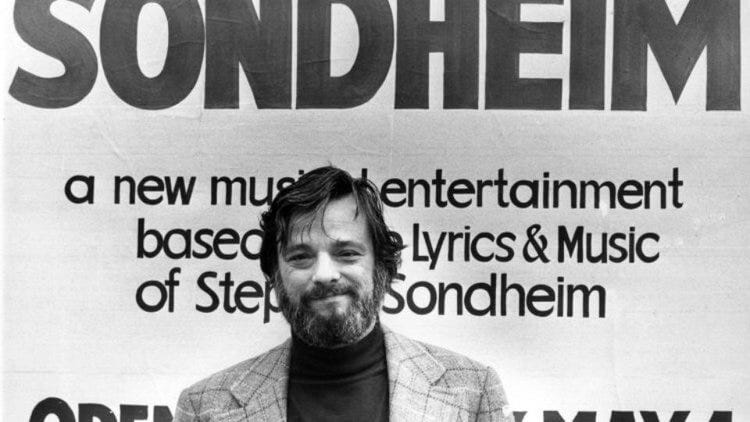
What Sondheim did better than anyone, better than any composer, any lyricist, arguably any dramatist of his generation, was write the inner monologue.
Not the declaration, not the swooning love song, not the triumphant eleven o’clock number in the conventional sense. The debate. The moment a character is caught between two versions of themselves, unsure which one to be.
Show after show, you can pick out the song where the character is in a debate, a dilemma, dwelling and uncertain about their choice or how to live or love, whether to be vengeful or hurt, resilient or sentimental.
He knew how to probe the inner dialogue so deeply and authentically that it is both magical and still believable.
I don't think anyone has done this better. I still don't.
Art As Craft
He believed in craft.
Not inspiration, not the romantic fantasy of a muse landing on your shoulder.
I know this from my study of orchestral conducting. You don’t stand in front of an orchestra and wait to feel something. The feeling, if it comes, is the reward for everything that happened before you raised the baton. The score studied until the printed notes grew blurry. The thousand small decisions made alone, in silent score study, before the downbeat of a performance.
What looks like electricity in the hall is actually an accumulation. Sondheim understood this completely.
In The Paris Review he famously credited his college music professor Robert Barrow. He was cold, antiromantic, teaching voice leading and harmonic analysis while other students complained. Barrow, he said, took all the mystery out of music and taught craft.
As Sondheim admited: “He changed my life by making me aware that art is craft, not inspiration.”
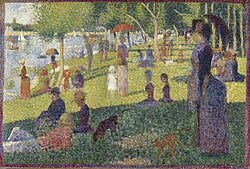
Which is why the Georges Seurat story inspired him so much. Five hundred thousand individual dabs of paint to create A Sunday Afternoon on the Island of La Grande Jatte — the painting that became the soul of his musical Sunday in the Park with George. “That’s 500,000 decisions,” Sondheim said. Not a lightening strike. Not a feeling. These were decisions, made one at a time, until his vision emerged.
Tolstoy said something adjacent to this, though he came at it from the recipient’s side rather than the maker’s.
His argument was that art is fundamentally an act of communication, not self-expression in the loose sense, but something more purposeful and more demanding.
The creator transmits a feeling, precisely and intentionally, and the recipient doesn’t simply understand it intellectually, they recreate the feeling within themselves.
The artwork is the vessel. If the transmission fails, the art fails. It’s a high standard and an honest one. It cuts through a lot of what gets called art and isn’t.
Sondheim, more than almost anyone I can point to, lived both sides of that equation. The craft that goes in, and the feeling that comes out, internalized.
Every song a transmission. Every lyric a decision. Every emotion felt within.
When I Realized All This
I first encountered Sondheim in 1979 on a school trip to Broadway. I was a teenager and I didn’t know what I was walking into.
But, I can recount it like it was last week.
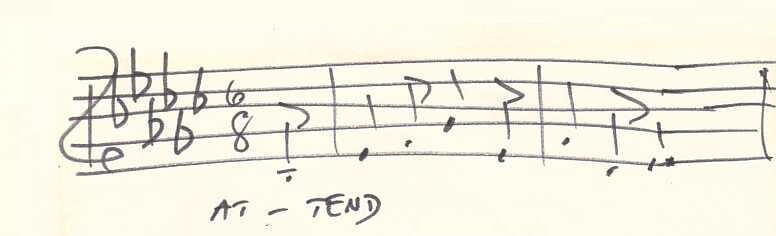
The house went dark at the Uris Theater. A solo organist began to play something ominous. And then—not a voice, not the orchestra—a shriek.
An almost human scream from a factory whistle that snapped every spine in my row upright.
A Londoner began to sing:
Attend the tale of Sweeney Todd
His skin was pale and his eye was odd
He shaved the faces of gentlemen
Who never thereafter were heard of again
I knew immediately I was watching something rare. I didn’t have the language for it yet. The music, the vengeance, the dark humor, the love story underneath all that blood, but I knew.
Six years later I was playing lead trumpet in the pit orchestra for Hofstra University’s production of Merrily We Roll Along, Sondheim’s legendary Broadway flop, the show that confused everyone and closed almost immediately.
I didn’t understand why. I liked it. The world agreed with me eventually.
Sondheim tells that Oscar Hammerstein II was a surrogate father figure to him after his parents divorced. He’s said that Hammerstein was so formative that had he been a geologist, Sondheim would have become a geologist.
How lucky we are that Hammerstein wrote musicals. But the story tells you where his drive came from. He was thirsty for guidance, for the craft, for a standard worth chasing.
Hammerstein handed him this standard and he spent the rest of his life raising it.
When Stephen Said Farewell
On November 26, 2021, I was actually looking for a Sondheim quote online, the one about art not being easy and about the craft of art.
When I hit the browser back button, the first thing I saw was the announcement of his death. He had died that morning. I found out while I was searching for his words.
I sat with that for a while.
In the days that followed, I kept returning to one specific performance.
Years earlier, Sondheim had played piano and sung at the memorial service for Michael Bennett, the director and choreographer, his friend, dead at 44 from AIDS-related lymphoma.
Sondheim chose to perform “Move On” from Sunday in the Park with George.
A song about not dwelling and finding the courage to move on.
About choosing to go forward even when the choice feels uncertain. He sang it to a room full of people who had just lost their friend, and he meant every word.
Stop worrying where you’re going, Move on.
If you can know where you’re going, You’ve gone.
Just keep moving on.
And then this: the line that informs your motivation.
I chose, and my world was shaken, So what?
The choice may have been mistaken
The choosing was not.
You have to move on.
Plus, this incredibly autobiographical lyric for Sondheim:
Stop worrying if your vision, Is new.
Let others make that decision —
They usually do.
You keep moving on.
Not the destination. The act of choosing. The commitment to keep moving even when you can’t see where you’re going.
At dinner, when someone would push back on my answer and say but what has he actually changed, I usually began with:
Among his many talents, composer, lyricist, and visionary, there is one particular trait that I believe lies at the core of all of his skills. His relentless motivation.
In interview after interview, in biographies and essays about Sondheim’s life, there is this river that runs through him of the need to push musical theater past it’s limits.
Always pushing for new ways of presenting stories and music, never happy with presenting a show in the norms of the time or status quo. He truly believed that unless he pushed the genre of musical theater, it may die. Keep Moving On.
His motivation, I believe, was his reverence for the Theater. A respect for what had preceded him and his responsibility to do what he could to keep it moving forward.
To take risks, even if a show might fail. The idea was to keep moving forward.
He had said in an interview with host James Lipton in an episode of Inside The Actors Studio when asked what profession he would most enjoy if not in the career he was in, I remember he immediately said, “Teacher.”
Teaching enables transformative success.
This is very apparent in the few masterclasses of Sondheim coaching singers that can be found on YouTube.
Each of them is a jewel of teaching and in witnessing ones inner dialogue on display.
A Masterclass With Sondheim:
Sondheim was a leader and a visionary, unafraid to push boundaries in musical theater and then push some more.
Name a living genius?
Stephen Sondheim was always my answer.
“Move On” from Sunday in the Park with George
I viewed the Bernadette Peters / Mandy Patinkin version more than a few times when I thought about Sondheim’s passing.
He was an arts leader with a passionate responsibility for advancing the genre of Musical Theatre and protecting it from its own demise.
“Move On” – Bernadette Peters and Mandy Patinkin
“Move On” – sung by Stephen Sondheim at the Memorial Service of Michael Bennett.
Two Words From Paul Anka I've Never Forgotten

There is a moment, early in any concert performance, when the audience is deciding whether it is going to have a good time or not.
Beyond The Booking: Lionel Richie

The moment Lionel Richie arrives at the venue and steps out of his black SUV, from my perspective, the show has already begun.
Backstage With Celebrity Talent

There's a thirty-second window that determines whether the $500K celebrity I booked for a private performance becomes legendary or merely expensive.