
Permission to Laugh
Inside Sondheim's Musical About the People Who Shot at Presidents

I am not making this up.
There is a musical, a real award-winning, performed-on-Broadway musical, in which a sinister carnival barker encourages a succession of deeply troubled Americans to cheer themselves up by shooting the President of the United States.
Step right up to Assassins, the Sondheim musical I attended last week.
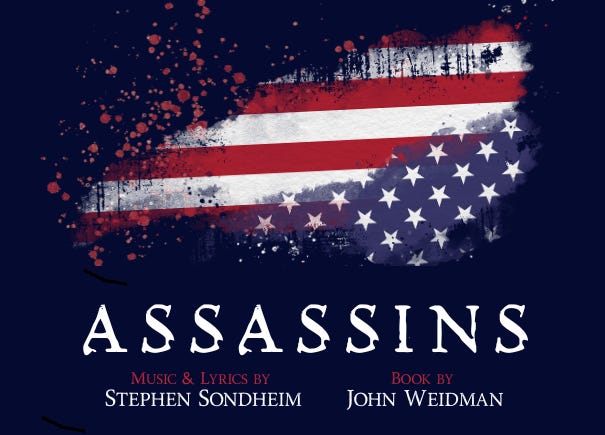
There are nine of them. They sing. They crack jokes. One does a cakewalk up the steps of his own gallows. Another records a heartfelt personal message to Leonard Bernstein from the front seat of a car. A car he is rushing to the airport to hijack a plane to crash into the White House. One assassin gets a tender ballad. Another gets recruited to join their club by all the assassins in the show.
But you, a reasonable, tax-paying, non-violent person, could never imagine yourself laughing during a show based on this material.
This is what Stephen Sondheim does to people.
A Sondheim Education
My relationship with Stephen Sondheim began the way the best theater education sometimes does: by accident, before I had the vocabulary to understand what I was hearing.
A high school trip to Broadway put me in the audience for the original production of Sweeney Todd. I knew nothing about Sondheim. I walked into a show about a homicidal barber and his landlady grinding human flesh into meat pies, scored with music of such intelligence and ferocity that I left the theater shocked and changed. I did not yet know the word “through-composed.” I did not need to. The experience bypassed the intellect entirely and went straight to the nervous system.
In college, I played lead trumpet in the pit orchestra for Merrily We Roll Along, a score that any brass player will tell you is among the most demanding and rewarding in the Sondheim catalog. Decades have passed. I studied scores, attended productions, and wrote about his craft.
But Assassins, his most controversial work, the one that divided critics when it opened and has only grown in stature since, had eluded me. I had listened to the cast recordings. I had read John Weidman’s book. I had watched the archival conversation in which Sondheim and Weidman walk through the show scene by scene, explaining their intentions to directors preparing new productions. I knew the show on paper but I had never been inside it.
Sondheim and Weidman
To understand Assassins, you need to understand the partnership that built it.
John Weidman was not a conventional musical theater writer. A Yale Law School graduate and the son of Jerome Weidman, who wrote the book for Fiorello!, he brought an intellectual discipline and a fearlessness that matched Sondheim’s own appetite for difficult topics.
Their collaboration produced three musicals. Pacific Overtures (1976) told the story of Japan’s forced westernization using Kabuki theatrical conventions on a Broadway stage. Assassins (1990) put nine presidential assassins in a carnival and asked the audience to stay for the ride. And the long-gestating Road Show, which went through multiple incarnations as Wise Guys and Bounce before reaching its final form in 2008, traced two brothers chasing the American dream across the Gilded Age.
Three shows. Not one of them remotely commercial. Every one of them had ideas that a more cautious writer would have walked past. What Sondheim found in Weidman was a collaborator willing to build stories no other writer would have attempted, and Weidman found in Sondheim a composer who could give those ideas emotional life without simplifying them. Pacific Overtures uses a Kabuki narrator. Road Show spans fifty years through the eyes of two con artists. Assassins asks you to laugh at people who killed presidents.
The Show
If you’re unfamiliar with Assassins, here’s your introduction.
Sondheim (music and lyrics) and Weidman (book) collapse 130 years of American history into a single carnival-like limbo where nine people who assassinated or attempted to assassinate a president coexist outside of time.
The show is based on an original concept by Charles Gilbert Jr., who began researching the lives of presidential assassins while in graduate school and recognized that their extreme behavior could be linked to motives and aspirations that are characteristically American.
A Proprietor runs the shooting gallery and hands out guns like prizes. A Balladeer narrates the received, optimistic version of American history through folk songs. The assassins push back.
The nine:
John Wilkes Booth → Abraham Lincoln (1865)
Charles Guiteau → James Garfield (1881)
Leon Czolgosz → William McKinley (1901)
Giuseppe Zangara → Franklin D. Roosevelt (1933)
Lee Harvey Oswald → John F. Kennedy (1963)
Samuel Byck → Richard Nixon (1974)
Lynette “Squeaky” Fromme → Gerald Ford (1975)
Sara Jane Moore → Gerald Ford (1975)
John Hinckley Jr. → Ronald Reagan (1981)
The show premiered Off-Broadway at Playwrights Horizons on December 18, 1990, directed by Jerry Zaks, with a cast that included Victor Garber as Booth, Terrence Mann as Czolgosz, and Debra Monk as Moore. It ran 73 performances.
The reviews were sharply divided.
“Distasteful, preposterous, and nasty,” on one side.
“A genuine original, thrilling, dazzling, and a brilliant achievement,” on the other.
The Gulf War was underway, and a musical about killing American leaders felt, to some, like an act of provocation.
The show did not reach Broadway until 2004, directed by Joe Mantello, with Neil Patrick Harris and Michael Cerveris. It won five Tony Awards, including Best Revival. Sondheim called it “probably the most exhilarating time I’ve ever had putting on a show because it was what it is today: sharp.”
The Trick
Here is the question the show had to answer before it could do anything else.
How do you get an audience to spend ninety minutes with nine people who tried to kill the president?
Weidman identified the obstacle precisely: “It’s become easy to shove these people aside, to view them as a collection of freaks, un-American freaks, people outside our experience who really have nothing to teach us and nothing to say to us.”
The show’s purpose was to dismantle that reflex. Not by arguing for sympathy. Certainly not by excusing the acts. But, by slowing the audience down.
Weidman again: “What we ask the audience to do is to step back beyond the moment of assassination.
In Hinckley’s case, for example, to stop thinking of John Hinckley as John Hinckley the assassin, to step back before the moment of the assassination and to see him as the deeply disturbed person that he was, living at the edge of stability, a kid with terrific problems which he was unable to resolve.”
Not sympathy. Not empathy. Weidman is precise about the distinction: “We simply ask them to see them as being more multi-dimensional and complicated than they are if we simply see them as a group of murderers.”
The mechanism for achieving this is humor. And the humor begins in the first ninety seconds.
Sondheim, describing what the opening number must accomplish: “The audience gets a tremendous amount of information that they need, not the least of which, and perhaps most important of which, is that they have permission to laugh. That although this is serious material, it’s going to be presented in a variety of ways, and one of the ways is it’s going to be very funny.”
The carnival shooting gallery is not mere stagecraft. It is the contract Sondheim and Weidman strike with the audience before the first assassin enters. Weidman warned directors preparing new productions: “I would caution people not to make it too ominous, too scary, too violent. I would also caution them not to make it too goofy, too silly.”
Once you’ve accepted the carnival, once you’ve laughed at the Proprietor cheerfully singing, “Hey, pal, feeling blue? Don’t know what to do? Come here and kill a president,” the distance between you and these people has already begun to close. And Sondheim has ninety minutes to use his intuition to close it further.
The most powerful of those tools is pastiche. Sondheim scored each assassin in the popular musical language of their era.
Booth gets a Stephen Foster styled ballad, chosen, Sondheim said, “because his songs always have that poignant feeling.” Guiteau gets an cartoonish cakewalk.
Hinckley gets a Top 40 love song deliberately scored to sound amateurish: “I’ve written in quarter rests at the end of each phrase to give it an amateur feeling,” Sondheim explained, because the dramatic conceit is that Hinckley composed the song himself. It should sound like a bad Carpenters track. It should sound like the work of a lonely, unstable kid who is not quite good enough to write the song he hears in his head. If the singer polishes it, the characterization vanishes.
John Hinckley Jr. duets with Lynette “Squeaky” Fromme
Sondheim was explicit: “If you bear in mind that each song has a central idea to it that’s different than each other song, the way each character has a central idea, then it will help give the continuity of the show and still maintain the variety and contrast.”
The Booth ballad is about misplaced political passion. The Roosevelt number is about publicity and the desperation for recognition. Zangara literally complained from the electric chair that there were no photographers, and Sondheim built a song around it.
During the Gun Song, one of the performers points his gun directly at the audience, slowly, person by person. Sondheim’s direction: “He should point it at every single person in the audience, because there’s nothing more upsetting in the theater than having a gun pointed right at you.” It leads to a joke (“First of all, when you have a gun, everybody pays attention”) but the seconds before the joke should be genuinely unnerving. It is the only moment in the show when the fourth wall breaks that way, and its power depends entirely on not rushing it.”
The tonal range across these numbers is not accidental. Sondheim used a vaudeville term: the show is routined, carefully sequenced so that the audience is “constantly jerked from a hilarious scene into a touching scene into a funny scene into a sentimental scene.” If two consecutive moments ever feel like they carry the same weight or the same style, “a mistake has been made.” The instability is the point. You never settle. You never find a comfortable posture from which to observe.
And the comedy, this is the part that must be believed in order to understand the show. The joke must always come from the characters’ absolute seriousness about what they are doing. Samuel Byck’s is a lunatic. His monologue to Leonard Bernstein should land him as a confirmed one. But Sondheim warned: the actor “must never ever lose sight of the reality of it. Byck is very intensely and seriously trying to communicate with Leonard Bernstein, and it’s that serious intent which will make the monologue work.”
Moore and Fromme’s botched attempt on Gerald Ford should be played for “flat-out low comedy,” but the two women “must never ever lose sight of the reality of the attempt which they are making. It must never seem as though it is unimportant to them to assassinate Gerald Ford. In fact, it’s out of their desire to accomplish this task that the comedy will come.”
The actors do not wink. The characters never know they are funny. They are desperate, deluded, enraged, heartsick, grandiose, and fully committed to solving their problems with a finger on a trigger.
The audience laughs because the collision between that earnestness and their staggering incompetence, their warped logic, their grotesque miscalculation of what a bullet can fix, is genuinely, darkly, uncomfortably hilarious. And having laughed, you cannot get the distance back. You are no longer watching freaks. You are watching people.
That is the trick.
And at the end, Sondheim and Weidman refuse to let you off the hook with a moral.
Sondheim: “I think if one attempted to draw a moral, it would either be simple-minded and banal and sententious, or it would be smug and undeserved on our part.”
The finale reprises the opening number, but played with what Sondheim called “a kind of dying fall, a kind of sadness” that was absent the first time. The show ends on a gunshot. “The last song does not draw a conclusion. It mustn’t. Everything in the show is both arguable and uncontroversial, and an audience should be stimulated through having a good time to talk about what the show is about and indeed perhaps to discuss or even argue it.”
No answers. No resolution. Only the recognition that these nine people are part of the American story, and that the carnival never really closes.
The Sarasota Players
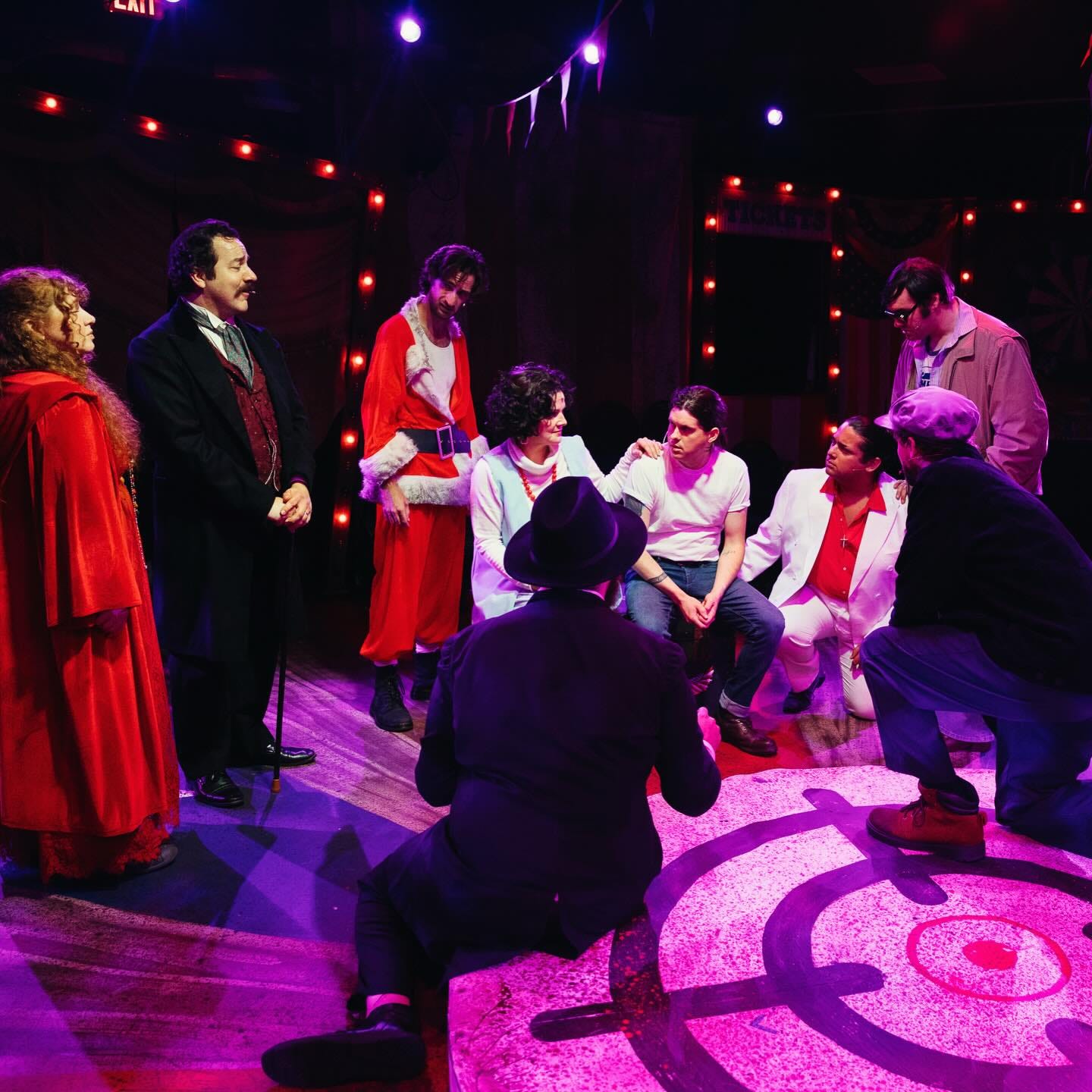
The Crossings at Siesta Key Mall. A community theater space carved out of a retail footprint that I’m sure once sold entirely different merchandise. The Sarasota Players, now in their 96th season, chose Assassins to close their year. A one-act show with no intermission, no love story, no happy ending, rated R by the licensing company. Not the safe choice.
Staged in the round with no proscenium. No backstage wall. The audience surrounds the playing area on all sides, and the story revolves. You find yourself physically moving to the action and never quite settled, never quite oriented. This instability mirrors the show itself. You are not permitted to sit back and watch from a comfortable distance. The subject is unsettling and the staging makes you feel it in your body, not merely in your head.
When a gun is drawn, it is pointed at you, and you also see other guns pointed at those seated opposite you. When Booth whispers to Oswald, he is close enough to see the gleam in his eye.
In the round, the carnival envelopes you. When the Proprietor hands out guns, the intimacy is relentless and it amplifies the messages Sondheim and Weidman built into the show. The humor lands harder because the performer’s face is a few feet from yours, and the horror lands harder for exactly the same reason.
Local Theater
I have attended community theater productions of Broadway musicals for years, and my experience has been remarkably consistent. The work is almost always top-notch. Authentic. Well thought out. Performed with a care and a passion that has nothing to do with profit.
These companies operate on shoestring budgets. There are no investors to satisfy, no box-office targets that determine whether the show will run another week. The profit motive does not enter the stage. And its absence releases the one thing a show like Assassins demands above all else: conviction.
Mel Brooks built the plot of The Producers on the satirical premise that a show designed to fail could make more money than a hit.
Community theater operates on the inverse principle entirely. There is no financial upside. The only reason to mount Assassins in a Sarasota mall is that the company believes in the work and believes they can honor it. That belief, held by every performer to every member of the set design team, is palpable from the first note of the opening number. And it is exactly what Sondheim and Weidman asked for. Every instruction they gave to directors preparing new productions comes back to the same demand. Commit fully, hold nothing back, never try to be cute with the material, never hedge. A community theater company that takes that demand seriously may be the most natural home this show has.
The Kids in the Next Row
I sat with twenty or so high school theater kids. A chorus of them really. Restless before the lights went down the way teenagers are, checking phones, talking across rows, radiating the benign chaos of any group of sixteen-year-olds asked to sit still in an unfamiliar place.
Then the show started.
They leaned in. They laughed when the Proprietor sang his pitch. They went quiet when Booth wrote in his diary. They reacted to the Gun Song not with the practiced cool of seasoned theatergoers but with the unguarded directness of young people encountering topics that treat them as adults. At the end they cheered. Not politely, but with the full-throated enthusiasm of an audience gripped by the material.
Several mentioned afterward that this was their first Sondheim show.
I thought about my high school trip to Sweeney Todd as I was roughly their age. Nobody told me what I was walking into. That single evening set in motion a relationship with music and theater that has shaped my life.
Both Sondheim and Weidman are gone. Their partnership produced three musicals that expanded the boundaries American musical theater. Their work does not need Broadway to survive and it does not need a giant budget either. It needs a committed company, an audience willing to sit still and experience it, and the nerve to do the show the way its creators intended.
And finally, Weidman describes: “What the show asks the audience to do is to spend some time with these people, and perhaps to discover as the show goes along that their feelings about them are at any rate more complicated than the feelings that they had when they came into the theater.”
Those twenty kids walked in not knowing the show. They walked out changed by it. I can imagine them pulling up the cast album on Spotify on the drive home.
Sondheim gave them permission to laugh at the unthinkable.
And the next generation of Sondheim devotees is born.


Happy Birthday, George!

George Gershwin - Born September 26, 1898, Brooklyn; Died July 11, 1937, Hollywood
Creating a Personal Mission Statement in the Performing Arts

For context, I have studied symphony and opera conducting at The Juilliard School and during the pandemic, completed a Master’s in Arts Presenting at the Frost School of Music, University of Miami where I am now an adjunct in the program. - Michael DeMarco